
At Sanghavi Electronics, we get this question every single day. Inverter AC vs Non-Inverter AC: Which AC is Best for Your Home? So we decided to write a clear, honest guide to help you understand the difference, weigh the pros and cons, and pick the right AC for your home and budget.At Sanghavi Electronics, we get this question every single day. So we decided to write a clear, honest guide to help you understand the difference, weigh the pros and cons, and pick the right AC for your home and budget.At Sanghavi Electronics, we get this question every single day. So we decided to write a clear, honest guide to help you understand the difference, weigh the pros and cons, and pick the right AC for your home and budget.
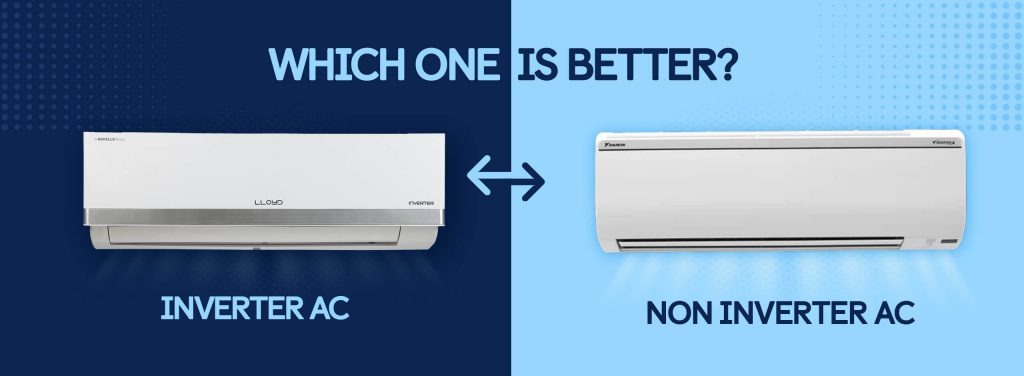
When summer hits and the heat becomes unbearable, an air conditioner stops being a luxury and becomes a necessity. But walk into any electronics shop today and you’ll face a choice that confuses most buyers — Inverter AC or Non-Inverter AC?
At Sanghavi Electronics, we get this question every single day. So we decided to write a clear, honest guide to help you understand the difference, weigh the pros and cons, and pick the right AC for your home and budget.
What Is a Non-Inverter AC?
A Non-Inverter AC is the traditional, older type of air conditioner that most Indian homes have been using for decades. It works on a simple principle — the compressor is either fully ON or fully OFF.
When you set your AC to 24°C, the compressor runs at full speed until the room reaches that temperature. Once it does, the compressor shuts off completely. When the room heats up again, the compressor kicks back on at full power. This cycle of switching on and off continues throughout the time the AC is running.
Think of it like a car that only drives at full throttle or stands still — there is no in-between.
What Is an Inverter AC?
An Inverter AC is the modern, smarter version. Here, the compressor does not switch on and off. Instead, it runs continuously but adjusts its speed depending on how much cooling is needed.
If the room is very hot, the compressor runs fast. Once the desired temperature is reached, it slows down just enough to maintain it — without ever shutting off completely. This variable speed technology is what makes inverter ACs far more efficient than their traditional counterparts.
Think of it like a car with cruise control — it adjusts its engine speed to maintain a steady pace without constant acceleration and braking.
Key Differences at a Glance
| Feature | Inverter AC | Non-Inverter AC |
|---|---|---|
| Compressor operation | Variable speed | Fixed speed (on/off) |
| Electricity consumption | Low | Higher |
| Cooling speed | Faster initial cooling | Slightly slower |
| Temperature consistency | Very consistent | Fluctuates slightly |
| Noise level | Quieter | Louder (due to frequent starts) |
| Purchase price | Higher | Lower |
| Long-term savings | High | Lower |
| Lifespan | Longer | Moderate |
| Best for | Daily/regular use | Occasional/seasonal use |
Electricity Bills — The Most Important Factor
This is where the real difference lies, and it is the number one reason why inverter ACs have become so popular across India.
A non-inverter AC draws the same high amount of electricity every time its compressor starts. Because it switches on and off so frequently, these power surges add up significantly on your monthly electricity bill.
An inverter AC, on the other hand, consumes only as much electricity as is actually needed at any given moment. Once the room reaches the set temperature, power consumption drops dramatically. Studies and real-world usage in Indian homes consistently show that inverter ACs save anywhere between 30% to 50% on electricity bills compared to non-inverter models of the same tonnage and star rating.
Over a 5-year period, the money saved on electricity bills by an inverter AC can easily make up for its higher purchase price — and then some.
Cooling Performance
When it comes to cooling your room quickly, inverter ACs have the edge. Because the compressor does not have to stop and restart, it maintains a more consistent cooling cycle and reaches your desired temperature faster.
Non-inverter ACs cool effectively too, but you may notice slight temperature fluctuations — the room gets a little warmer between compressor cycles before it kicks back on. For most people this is barely noticeable, but in extremely hot climates or peak summer months, it can make a difference.
Noise Levels
Every time a non-inverter AC compressor starts, it creates a sudden surge of noise — that familiar loud hum you have probably heard many times. In a quiet bedroom at night, this can be disruptive.
Inverter ACs run at a lower, steadier speed and therefore produce significantly less noise. If you plan to install an AC in a bedroom or study, an inverter model will give you a much quieter and more comfortable environment.
Lifespan and Maintenance
Because a non-inverter AC compressor is constantly starting and stopping at full power, it experiences more mechanical wear and tear over time. This means more chances of breakdowns and a generally shorter lifespan.
An inverter AC’s compressor runs smoothly and continuously at varying speeds, putting far less stress on the motor. As a result, inverter ACs tend to last longer and require less frequent repairs — though any AC, inverter or not, should be serviced at least once a year for best performance.
Price — Upfront Cost vs Long-Term Value
This is the most common hesitation buyers have. Inverter ACs are priced higher than non-inverter models — sometimes by ₹5,000 to ₹15,000 or more depending on the brand and tonnage.
However, look at it this way:
- If you use your AC for 6 to 8 hours a day through the summer months, an inverter AC can save you ₹2,000 to ₹4,000 or more every month on your electricity bill.
- Within one to two cooling seasons, the price difference is recovered through savings.
- After that, every month is pure savings in your pocket.
So while a non-inverter AC is cheaper to buy, an inverter AC is cheaper to own.
Star Ratings — What You Need to Know
In India, all ACs are rated by the Bureau of Energy Efficiency (BEE) on a star scale from 1 to 5. More stars means more energy efficiency.
Importantly, inverter ACs and non-inverter ACs have separate star rating scales. A 3-star inverter AC is significantly more efficient than a 3-star non-inverter AC. When comparing, always check the ISEER (Indian Seasonal Energy Efficiency Ratio) value — the higher the number, the more efficient the unit.
At Sanghavi Electronics, we always show you the BEE star label and ISEER value so you can make a fully informed decision.
When Should You Choose a Non-Inverter AC?
Despite all the advantages of inverter ACs, there are situations where a non-inverter AC still makes sense:
- Budget is a strict constraint and you need the lowest possible upfront cost.
- Usage is very occasional — for example, a guest room that is used only a few times a year. With minimal usage, the electricity savings from an inverter AC will take many years to recover the price difference.
- Short-term installation — if you are in a rented space and will not be there long enough to benefit from long-term savings.
When Should You Choose an Inverter AC?
An inverter AC is the right choice if:
- You use your AC daily or for long hours, especially through the entire summer.
- You want lower electricity bills every month.
- You prefer quieter operation, especially in a bedroom or children’s room.
- You want a longer-lasting appliance with fewer breakdowns.
- You are installing in a living room or master bedroom where comfort and consistency matter.
For most Indian families using their AC regularly, an inverter AC is the smarter and more economical choice in the long run.
Which Brands Does Sanghavi Electronics Recommend?
At Sanghavi Electronics, we stock inverter and non-inverter ACs from all leading brands including LG, Samsung, Voltas, and Haier — across 1 ton, 1.5 ton, and 2 ton capacities.
Our team will help you choose the right brand, the right tonnage for your room size, and the right star rating for your usage pattern and budget. We also assist with installation and connect you to authorised service centres for warranty support.
Final Verdict
| Inverter AC | Non-Inverter AC | |
|---|---|---|
| Best for | Regular, daily use | Occasional use |
| Running cost | Lower | Higher |
| Upfront cost | Higher | Lower |
| Comfort level | Excellent | Good |
| Our recommendation | ⭐ Preferred choice for most homes | Budget option for low usage |
If you are buying an AC for regular use in your home, go with an inverter AC. The higher upfront cost pays for itself quickly through electricity savings, and you will enjoy quieter, more consistent cooling for years to come.
If your budget is tight and your usage will be minimal, a non-inverter AC can still serve you well.
Still Not Sure? Come Talk to Us.
At Sanghavi Electronics, we do not believe in one-size-fits-all recommendations. Every home is different — room size, usage hours, budget, and preference all matter. Visit our store or reach out to us and our team will help you find the AC that is truly right for you.
Sanghavi Electronics — Honest Advice. Quality Products. Happy Homes.